





Navigating conversations that you know matter, but aren’t always easy to have
By Dr Anita Devi
Ever been stuck for words? Effective Communication skills are not something we are born with, but acquire, nurture and develop over time and experience. Some may claim to have a natural flair due to their personality, but it is hard to know if this is the by-product of opportunity or role models. At the heart of effective business leadership is investing in good relationships.
“One good reviewer can bring in ten new clients, one negative experience (if not handled well) has the potential to reduce our client base over night”
This shouldn’t cause us fear or even a desire to constantly seek validation. It’s an opportunity to reflect, define our authenticity and communicate our perspective clearly.
Take some time and consider moments, when …
- you’ve had to chase payment for an overdue invoice
- providing feedback to your team has resulted in sleepless nights
- an extension is needed on a project that you were commissioned to deliver and asking seems hard
- an employee isn’t pulling their weight and you need to talk to them
- a director has posted something inappropriate on social media
- you need to request an extension on a bank loan
- salary and compensation negotiations prove necessary in difficult financial times
- a supplier has started producing sub-par components and this affects the whole supply chain
- a misprint in a communication presents the complete opposite image of the organisation and reputational damage is real possibility
- contract termination is inevitable
I’ve been there. In all these scenarios consider for you, what went well and what could be even better? I am sure you can add many scenarios of your own. These situations are awkward and stressful. They are the type of thoughts that keep us all awake at night. Going into these conversations or situations, can feel like an exam, that we sit 3 times!
- There is the rehearsal prior to the conversation, imagining all possible scenarios, choosing which words to use, thinking about pose, posture, voice tone and facial expression … it’s exhausting!
- Next, there is the actual conversation itself. No conversation ever goes how we planned it, so on the day, there is often a lot of thinking on our feet.
- Finally, after the conversation, we play it over and over in our head: Could I have handled it differently? Why were they so upset? S/he said X, I said Y … but their face ‘meant’ B.
It goes one and before we know it, we are into the next difficult conversation.
These types of difficult conversations require us to problem solve, retain agency, listen with empathy, communicate effectively – all whilst taking a stand from our own viewpoint.
To speak or not to speak is not the question!
Speaking on stage for a ‘planned’ speech in my work context doesn’t phase me. In fact, I enjoy it. I know my area and I can communicate this to others effectively. I use stories, graphics and humour to connect with the audience, whether online, face to face, a small group of 20 or in fact 250. What has always flummoxed me, was thinking on my feet in response to a question or comment. Phase 3 took over my thinking zone fulltime – Did I say the right thing? Could I have said it better? Did they understand me? What if I had used these words instead? When I started my doctoral studies, I knew at the end of the journey, I would be required to ‘defend’ my thesis – an original thought and the subsequent research. In 3 minutes, I needed to explain 4 years of study – that was what I was told! This was scary! So I joined a local Toastmasters International Group. This was brilliant. Every two weeks we would gather to either present or listen to a range of speeches – prepared and impromptu. What fascinated me the most was the feedback speech and the evaluation speech on the feedback speech. Sounds complicated, but it wasn’t. It was a smooth routine in a safe environment that truly helped us slow down and receive feedback. At work, if I was invited to give a keynote somewhere, the feedback tended to be extreme – either is was great or I missed the mark. No one took the time to explain the details of the feedback. At Toastmasters International, I received granular feedback. For example, my wisdom teeth have grown horizontally. This has affected my jaw and how wide I open my mouth when speaking. I was presenting a speech at Toastmasters one evening and my reviewer commented on a clicking noise that happens between words. Subtle, but nonetheless present. At first, I was in denial. The following session, another reviewer (who wasn’t present previously) made a similar comment. They didn’t think it was irritating, but just a distraction. This awareness changed ‘how’ I opened my mouth to let the sound out. No more clicking noises! Some of the reviewers even count the ums and ahs.
One of the most effective elements for me at Toastmasters was the impromptu speaking. I learnt to think on my feet. You can see it in politicians – the ones who effectively and authentically bat off questions tend to deescalate conflict. Whilst others, respond in a way that annoys the audience and escalates the problem. I’m not not talking about avoiding situations, just handling them differently. My oral exam at the end of my PhD lasted for 2.5 hours! Yes, 150 minutes of questioning from a very awkward External Examiner. Even the awarding university, said this was the toughest oral examination they had ever seen … but I was prepared by the impromptu speech practice and feedback.
Managing Difficult Conversations
Difficult conversations involve both planned and impromptu elements in the context of shared problem solving. Whilst I had passed my PhD oral exam, I knew there was more for me to learn. I work in a high conflict environment. Conflict, in itself doesn’t phase me – put two people in a room and you will have a difference of opinion. Difference is healthy. I do not want to walk in a garden where all the flowers look the same. I value variety and so with humans I accept conflict is part of the journey. What challenged me in conflict was the question, “How to remain kind, caring and compassionate in a difficult or conflicting conversation?” I wanted to protect my heart and the relationship. I knew difficult conversations are inevitable, but they do not have to destroy me or my passion.
I started researching and I would hear people talk about aggressive vs assertive models … the extremes model wasn’t for me. I also read about people who referred to ‘Fierce Conversations’ … I wasn’t looking to scare others into submission. I wanted to know “How to remain kind, caring and compassionate in a difficult or conflicting conversation?” My curiosity took me to a study by the Harvard Business School. This study showed me ‘how to manage’ difficult conversations. A difficult conversation isn’t about ‘winning’ but preserving, restoring and empowering everyone involved. I do not claim to be perfect, by any means … but I certainly am a better and more confident person for investing time in learning how to manage difficult conversations, like the ones listed above.
I want everyone to have this …
I was so enthused by what I had learnt and how it changed my approach (on the inside and outward), I wanted everyone to have this. So I wrote a one-day accredited course on this. We started to deliver and the feedback has been amazing, with people sharing how different this approach is. As I shared, I work in a high conflict environment, but the very people I thought would benefit from this … cannot see the need. They thrive in the conflict zone, because (as employees not employers) they want to be right, on top and recognised. They do not want to know “How to remain kind, caring and compassionate in a difficult or conflicting conversation?” In business this is imperative.
“Sadly, they do not know, what they do not know”
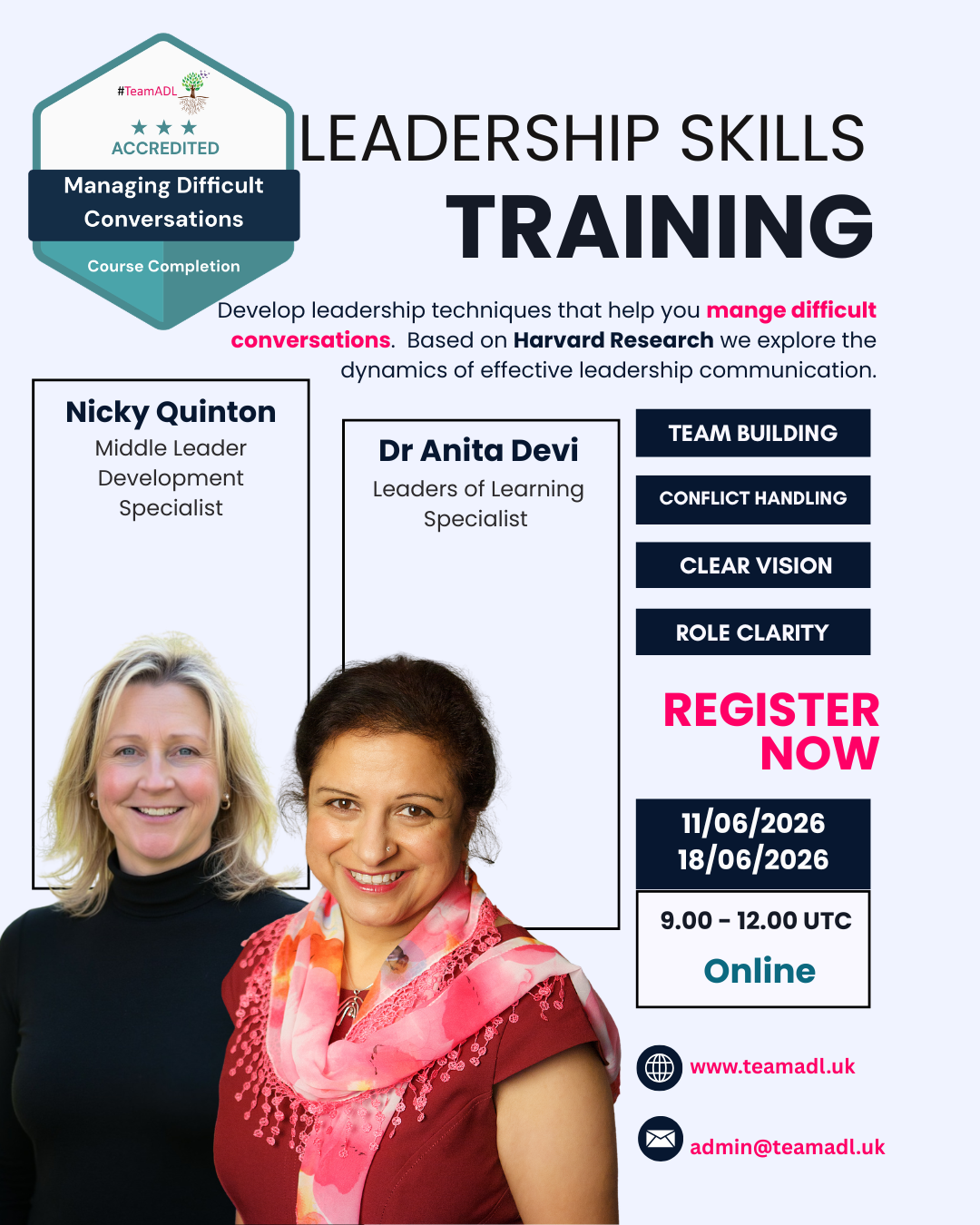
I hope this is not you! We will be hosting an online version of the accredited ‘Managing Difficult Conversations’ shortly in two online half day slots. If you think this is something that would benefit you and enhance your business leadership, why not join us. We would love to have you on the course as a participant. Details are given below.
If you are someone, who needs support in preparing a talk or writing an editorial, do get in touch. A one-to -two hour coaching session can turn a talk or article into gold. “But Anita, you know nothing about my sector, how could you help me?” When I chose my PhD Supervisor, I intentionally chose someone who knew nothing about my specialist field. Why? It taught me how to truly explain what I was saying to a novice. An expert would have made assumptions about my research, but a novice asked questions. Questions that helped me grow to communicate more effectively.
I look forward to meeting you – online for a course, in a coaching session or at a local coffee shop. And if you are interested in Toastmasters International, there are a few branches in Milton Keynes and Northampton, I could recommend. I earned my full accreditation and several awards from them. I even attended a Toastmasters Club in Los Angeles (USA) – that’s a story for another time! I no longer attend, as I am currently upskilling my enjoyment through Bulgarian Dancing! I am the only non-Bulgarian in the group 😉
Till next time …