







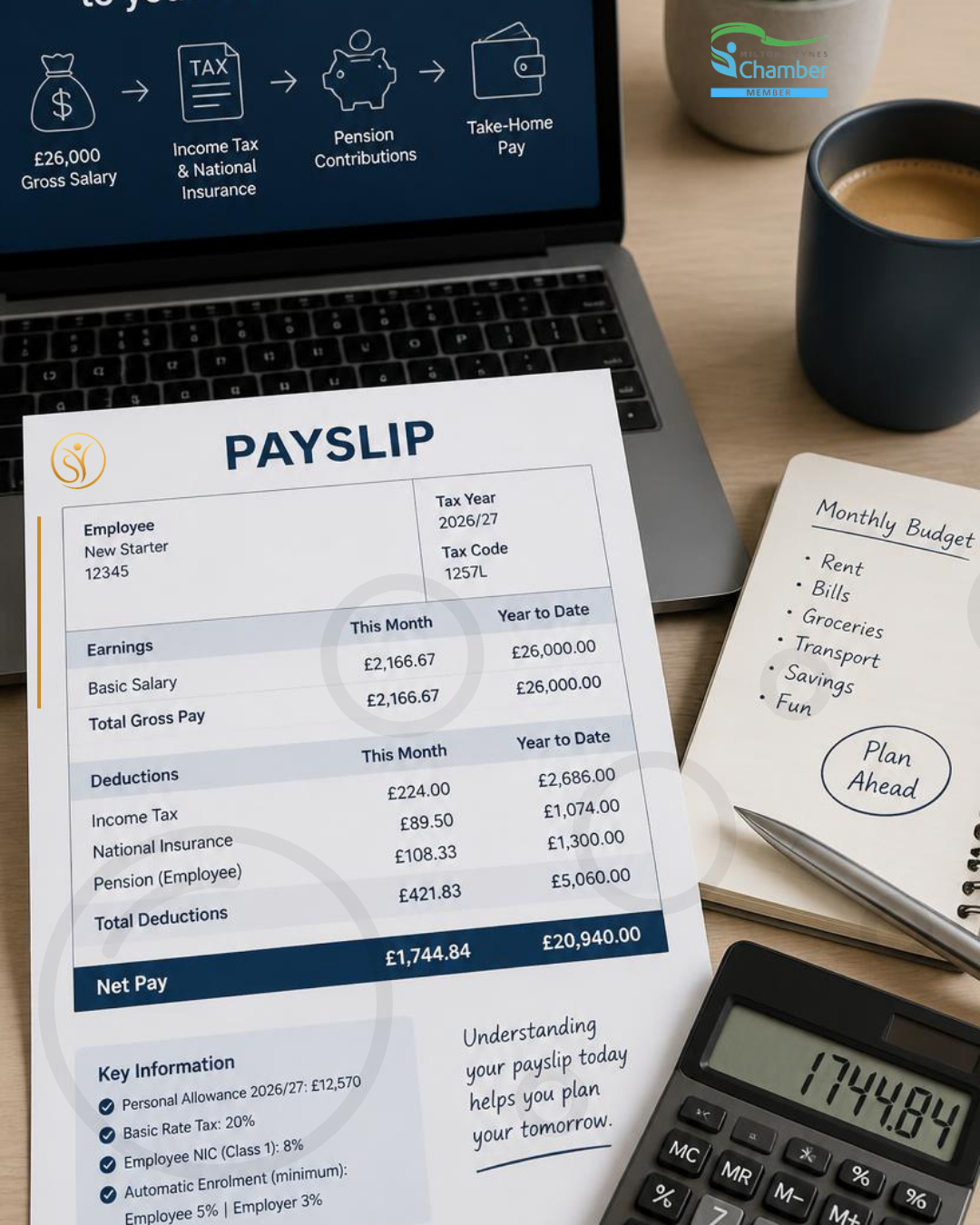
Your First Payslip: Where Does Your Salary Go?
Imagine you have just accepted your first full-time job on a salary of £26,000 a year, it sounds straightforward: £26,000 divided by 12 gives you approximately £2,167 a month. But that is your gross monthly pay, not necessarily the amount that will land in your bank account.
For the 2026/27 tax year, the standard Personal Allowance is £12,570, meaning the first £12,570 of your annual income is generally free from Income Tax if you are entitled to the standard allowance.
So, on a £26,000 salary, roughly £13,430 falls within the basic Income Tax band, at 20%, that works out at approximately £2,686 in Income Tax over the year, or around £224 per month.
National Insurance is calculated separately; For most employees, the 2026/27 Class 1 rate is 8% on earnings between the relevant monthly threshold and the Upper Earnings Limit. On a £26,000 salary, that works out at roughly £1,074 a year, or about £90 a month.
That takes the estimated monthly pay from around £2,167 gross to approximately £1,853 after Income Tax and employee National Insurance, before considering other deductions.
Then there is your workplace pension. If you are eligible for automatic enrolment, the minimum total contribution is generally 8% of qualifying earnings, with at least 5% coming from you and 3% from your employer. The exact amount deducted from your pay can vary depending on how your pension scheme calculates contributions.
So, your final take-home pay can be lower than £1,853 once pension contributions, student loan repayments or other deductions are included.
This is why your first payslip is worth understanding rather than simply checking the final number. Your tax code helps determine how much Income Tax is deducted, while your National Insurance and pension contributions show where other parts of your pay are going. For the 2026/27 tax year, 1257L is the standard tax code for someone receiving the standard Personal Allowance, although individual circumstances can result in a different code.
If your pay slip shows a different code, such as BR or 0T, it does not automatically mean you have been overtaxed, but it is worth checking why that code has been applied. HMRC provides tools for checking your tax code and estimating whether you are paying the correct amount of Income Tax.
Understanding your pay slip may seem like a small part of starting your career, but it is part of becoming financially confident at work. When you know what you earn, what is being deducted and why, your first salary becomes more than a number in your bank account, it becomes something you can actually plan around.